Photo by Planet Volumes / Unsplash Ed Meadow How to Come Back to a Novel You Haven't Touched in Months Maybe it's been six weeks. Maybe six months. Maybe you keep moving the manuscript from one week's to-do list to the next, telling yourself you'll open it when you have a proper afternoon free. Then you finally do. The file opens on Chapter 23, halfway through a conversation you vaguely remember writing. Someone is angry. Someone is hiding something. There's a reference to a phone call you're fairly sure happened earlier in the book, though you couldn't say exactly when. You scroll up. Then fur
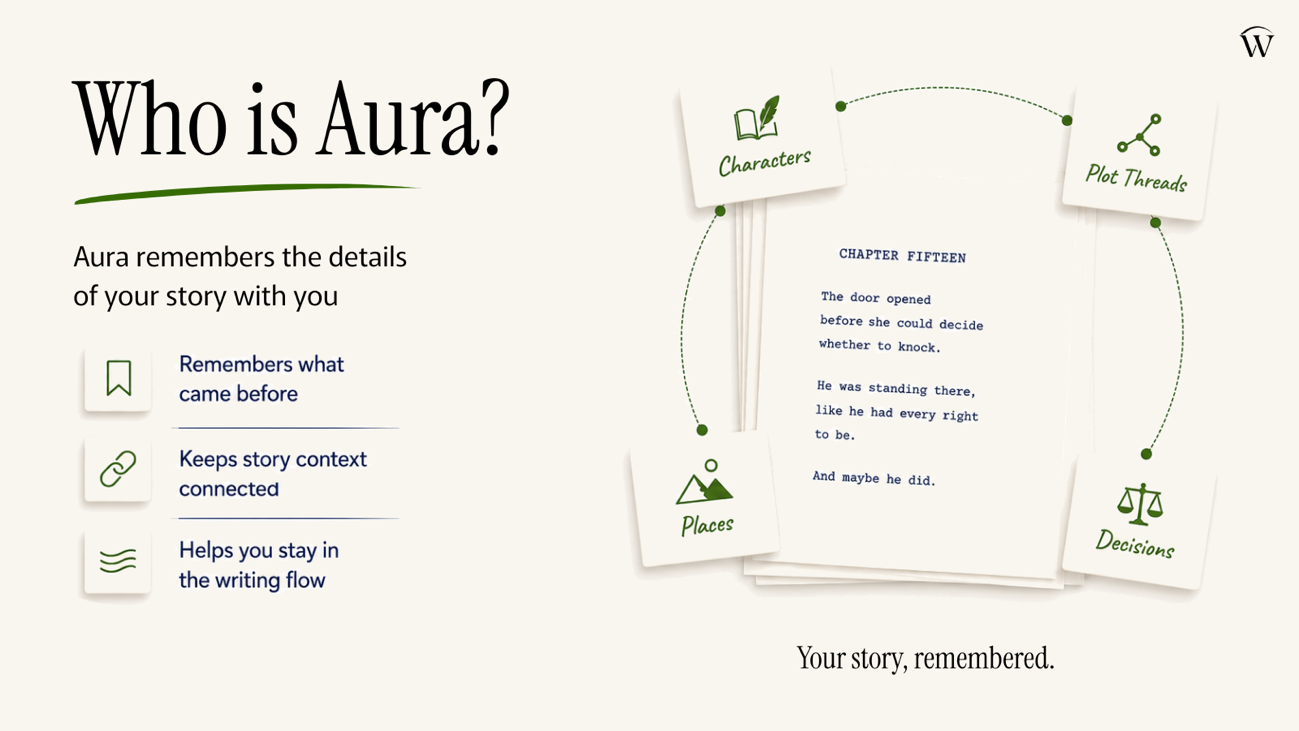
Graphic: Carolina Correa de Souza Ed Meadow Meet Aura, Your New Writing Companion Who Never Forgets Your Book Meet Aura, the part of WriterScribe that already knows the book you're building.
Photo by charlesdeluvio / Unsplash Ed Meadow The part nobody warns you about writing There is a particular kind of unfinished novel that is difficult to explain to anyone who has never tried to write. You know the one. Not the idea you had once and wrote three paragraphs of before you forgot about it. The other one. The manuscript that's still open in a folder on your laptop, the one you think about in the shower, or driving, or lying awake when you should be asleep. Tuesday night. The house is quiet. You open it. You read the last few pages to find your place. Something's off
Ed Meadow Can I Sell a Book Written With AI on Amazon KDP? (2026 Rules) The short version: Yes. Amazon KDP allows books created with AI and does not ban them. The rule turns on one distinction: if AI generated the text, images, or translations in your book, you must disclose it when you publish. If AI only assisted — brainstorming, refining, or editing writing you created yourself — no disclosure is required. Amazon judges this on who created the content, and counts it as AI-generated even if you edited it substantially afterward. It’s the question that stops
Ed Meadow Craft, Structure, Finish — How to Actually Complete Your Novel The short version: Most novels are started and never finished — they stall in the middle, where the story’s threads outgrow what a writer can hold in their head. WriterScribe is built around three stages — craft, structure, finish — that keep a long manuscript consistent so it reaches completion. Its emphasis is finishing, because for indie authors the number of books completed is the strongest driver of income. Every writer can start a novel. The hard part — the part almost nobody talks
Ed Meadow Your Voice, Your Prose — AI That Writes With You, Not For You The short version: WriterScribe is an AI novel-writing tool built on a single principle: the writing stays in the author’s own voice. Unlike tools that generate prose in a fixed house style, it continues the writer’s existing style, keeps the work the author’s own, and never trains on user manuscripts. This makes it AI-assisted — author-directed — rather than AI-generated, the distinction marketplaces such as Amazon KDP use to decide what may be published. There are two kinds of AI writin
Ed Meadow Sudowrite vs NovelCraft: The Third Question Nobody's Asking The short version: Sudowrite is the fastest AI writing tool to start with, but it works its own way. NovelCraft is the most configurable, but you build a codex and manage settings before the writing flows. Both are good. The question neither answers: what if you want a tool that already knows your story and simply lets you write — no workflow to learn, no database to build? If you’re weighing Sudowrite against NovelCraft, you’ve already done the hard part. You’ve left the blank-page tools
Ed Meadow What to Look For in an AI Writing Tool That Actually Remembers Your Story The short version: A writing tool that “remembers your story” keeps a persistent record of your characters, world, and plot, and supplies it to the AI every time you write — so you never re-explain. Three things separate the good ones: it remembers without manual setup, it writes in your voice rather than its own, and it never trains on your work. Once you’ve felt the problem — the AI that forgets your protagonist’s eyes were grey, that resurrects a character you killed two chapters ago,