

You are thirty-seven thousand words into a novel.
Your protagonist hasn't spoken to her brother since chapter six. There's a reason for that. A good one. The kind of reason that changes the meaning of a conversation they're about to have now, nine chapters later.
It's Thursday evening. You have an hour to write, and you're stuck on the scene. So you open an AI chat to think it through out loud.
Except before it can help you, you have to explain who the brother is.
Then the argument.
Then what happened before the argument.
Then what she knows, what he knows, and what the reader already knows.
By the time you're done explaining, the hour is half gone, and you haven't thought about the scene at all. You've spent your writing time narrating a book you already wrote, to something that will forget it the moment the window closes.
If you've written anything longer than a short story, you already know this problem.
It's a memory problem. It's the problem WriterScribe was built to solve. And Aura is the companion that will assist you along the way.
The fix wasn't a bigger chat window or a longer memory string. It was rethinking what an AI actually needs to hold onto, and how.
Remembering isn't the same as having a long conversation
General AI works with context — whatever it can hold in front of it while it's generating a reply. For a short conversation, that can feel a lot like memory. Tell it Mara is afraid of water, and a few messages later, it "remembers" that Mara is afraid of water.
But a novel isn't a few messages.
A novel is Mara's fear of water, and the reason for it, and the lake behind her childhood home, and the lie her father told about what happened there, and the necklace she lost in chapter three, and the person who finds it in chapter nineteen, and several hundred other details that seemed small when you wrote them and turned out to matter later.
At some point, a story gets too complicated to treat as one very long chat. Even a generous context window is still a window — it's trying to hold pages and pages of prose and guess, from all those words, what actually matters right now.
But that's not how you remember your own book.
You don't remember it as a wall of text. You remember that Mara won't go near the lake. That Daniel already knows the truth. That the key is still in the kitchen drawer. That two characters can't meet yet, because one of them is supposed to believe the other is dead.
A story has structure. So that's how WriterScribe holds onto it — not as a transcript, but as the same kind of structure you already carry in your head.
Your book, underneath the prose
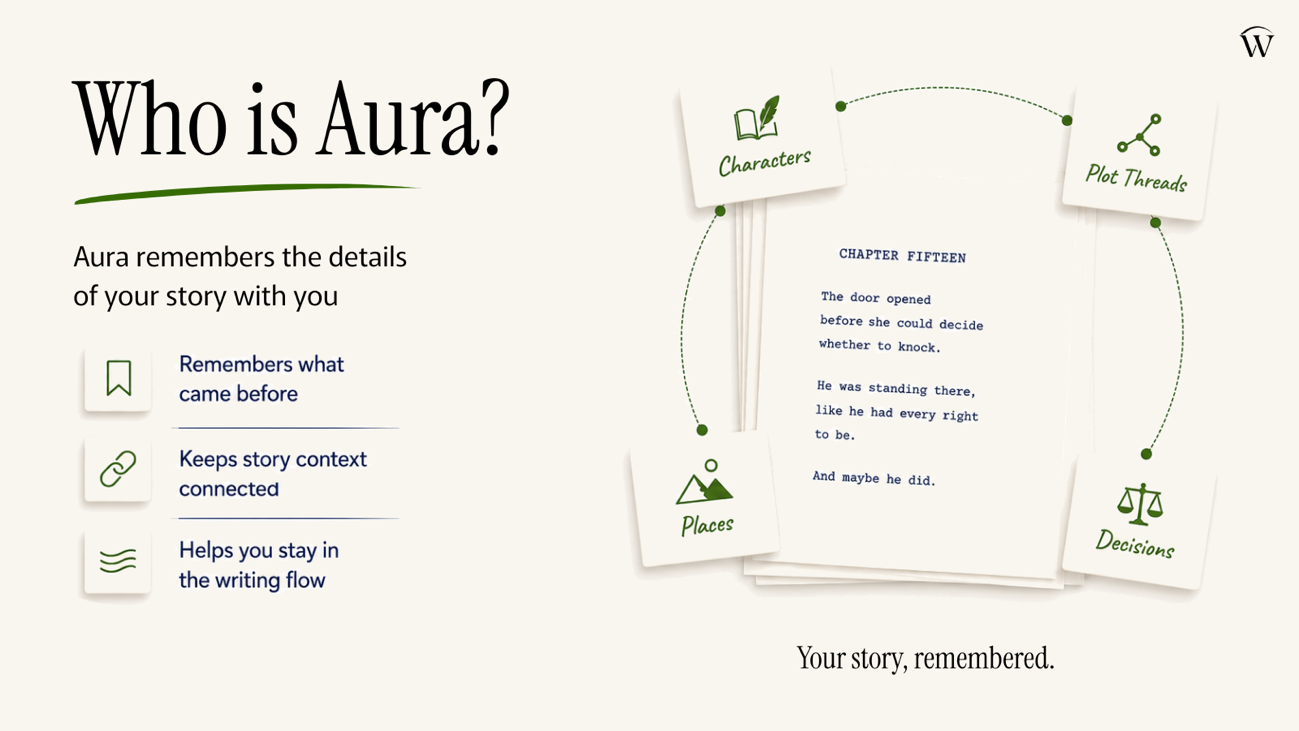
Inside WriterScribe, the load-bearing parts of your story become what we call your Story DNA — characters, relationships, arcs, places, the rules of your world, what's happened so far, and the decisions you've made that need to stay true for what comes next to make sense.
If you already have a manuscript, you're not starting from a blank form. WriterScribe remembers the work you've already done — and you're the one who decides what goes into your Story DNA and how.
And it stays yours. Your manuscript is never used to train anyone's model — not ours, not anybody else's. Your book is in WriterScribe so that Aura can be useful about it, and for no other reason.
That distinction matters to us, because memory shouldn't turn into another administrative job standing between you and the actual writing.
You shouldn't need a spreadsheet you update after every scene. You shouldn't be maintaining a document called FINAL CHARACTER NOTES V7 that you're a little afraid to open. You shouldn't have to paste three paragraphs of "previously on my novel" into a chat window every Saturday morning just to get back to where you left off.
The book you wrote already has all those details, and WriterScribe gives them somewhere to live.
That's the part underneath. The part you actually talk to is someone else entirely.
So who is Aura?
Aura is the part you actually talk to. But she isn't a chatbot sitting next to your manuscript, guessing at it fresh every session. She works from the story WriterScribe has already been holding underneath.
That means when you ask about a scene, she's not meeting your characters for the first time. When you come back after three weeks away, the story hasn't evaporated because the conversation ended. When you're deep into the back half of the book, you don't have to re-introduce her to something you set up in chapter four just so today's question makes sense.
Aura already knows the book you're building. Not some generic version of it. Not what "should" happen next, according to some pattern she's seen before. Yours — the version where the sister left home at seventeen, where the winter lasts six months, where that small, easy-to-miss conversation in chapter four is absolutely going to matter later.
She can brainstorm with you, help you think through a knot in the plot, flag a continuity slip, work through an edit, or help with the words themselves when you ask. But she's not there to become the author of your story. The decisions stay yours. Memory doesn't hand Aura ownership of the book — it just gives her enough context to actually be useful about it.
Which, underneath all of it, is really the whole reason this exists.
What memory actually buys you
By the time a novel becomes a novel, it has a past — things that happened, characters who changed, promises made to the reader, small details that picked up meaning they didn't have in the first draft. Somewhere around the middle, holding all of that in your head stops being effortless. That's the real cost of forgetting: not that the story disappears, but that you spend your limited writing time rebuilding it instead of moving it forward.
That's what the memory is for. Not so Aura knows more about your novel than you do — so you're not the only one carrying it. Whether Daniel can realistically accuse Mara of lying in this scene. What she told him three months ago. Whether you've quietly contradicted yourself somewhere. Aura doesn't take any of that complexity away. She just remembers it with you.
So when you open the book on a Thursday evening with one free hour, you don't spend the first twenty minutes explaining who the brother is. You start with the question you actually came to ask.
What happens when he walks into the room?
And then you get back to the part that was always yours. Writing.
Start with your own book.
WriterScribe is free to try, and you don't have to start from a blank form — bring the manuscript you already have and see what Aura makes of it.
Your voice. Your prose.